Morphological Shattering
Interspeech 2026
Morphology-aware subword learning for Hindi, Marathi, and Gujarati that preserves akshara integrity and reduces Morphological Shattering.
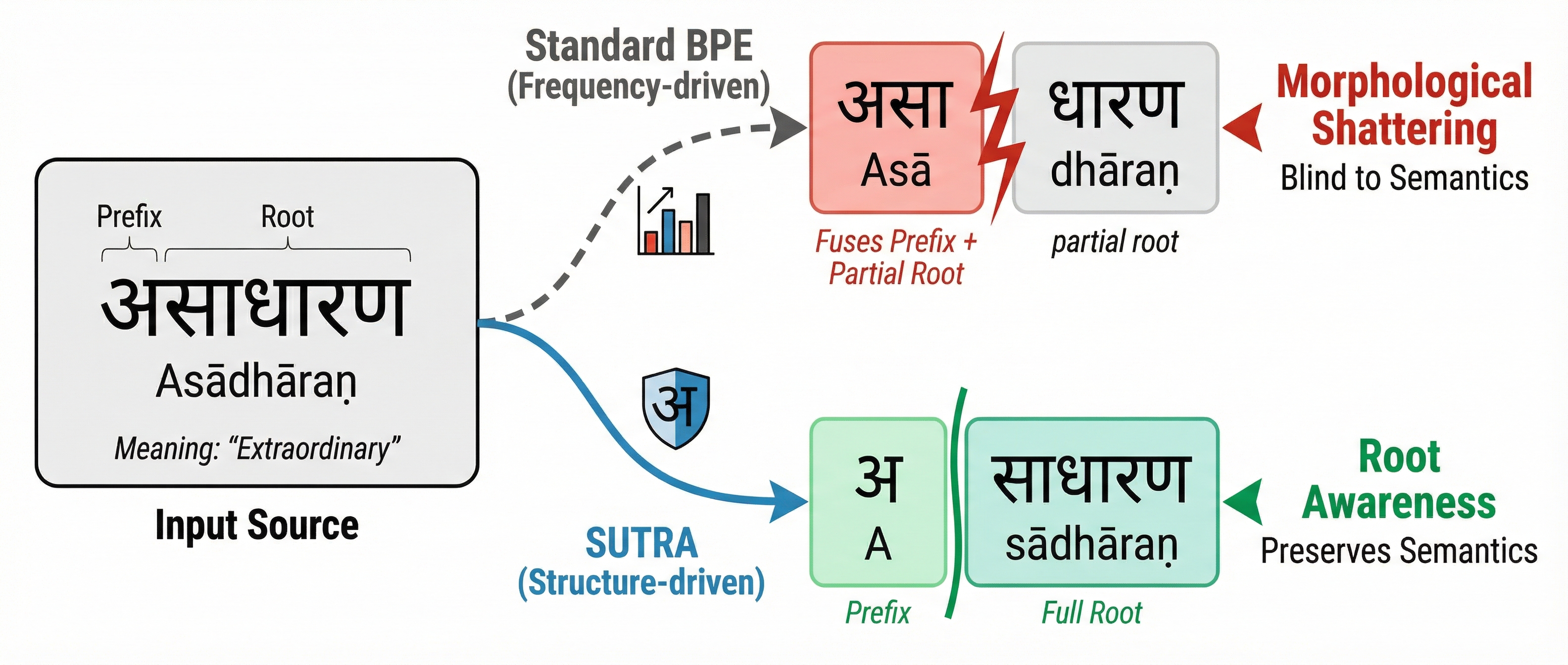
Existing subword tokenizers optimize statistical compression but ignore morphological structure, particularly the relationship between roots and affixes. This is harmful for morphologically rich Indic languages, where basic units are complex orthographic syllables (aksharas) rather than letters. Frequency-based methods over-fragment words, arbitrarily splitting roots and affixes—a phenomenon we term Morphological Shattering.
We propose SuTRA (Structurally-Unified Tokenization with Root Awareness), a morphology-aware algorithm that preserves akshara indivisibility and penalizes merges crossing morphological boundaries. We also release a new morphological segmentation dataset for Hindi, Marathi, and Gujarati. SuTRA reduces shattering, achieving peak gains of +14.7% in morphological alignment (Boundary F1) and +34% in semantic recoverability (Hindi) over BPE. These structural gains yield an average improvement of +8.08 chrF2 in machine translation.
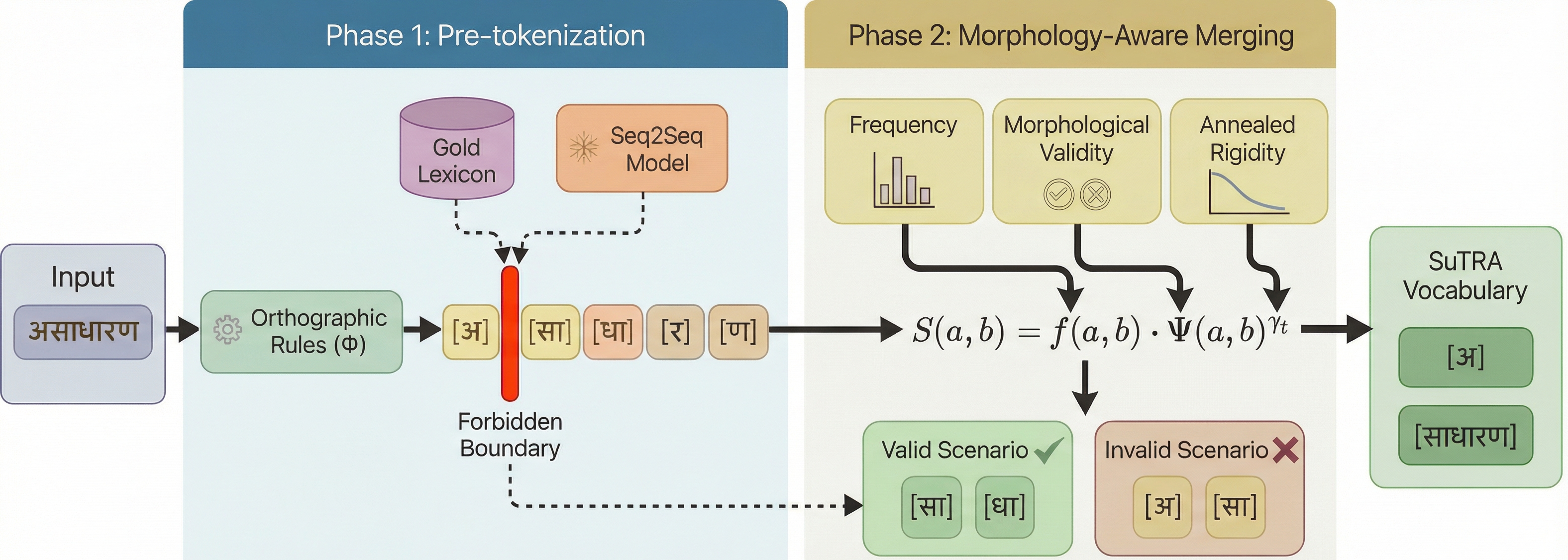
SuTRA operates in two phases. Phase 1 (Pre-tokenization) applies orthographic rules Φ to group characters into akshara-like units and marks forbidden boundaries using a gold lexicon or a seq2seq model for OOV words. Phase 2 (Morphology-aware merging) runs BPE-style training with score S(a, b) = f(a, b) · Ψ(a, b)γt, where Ψ downweights merges that cross morpheme boundaries and γt is annealed from strict to permissive over training.
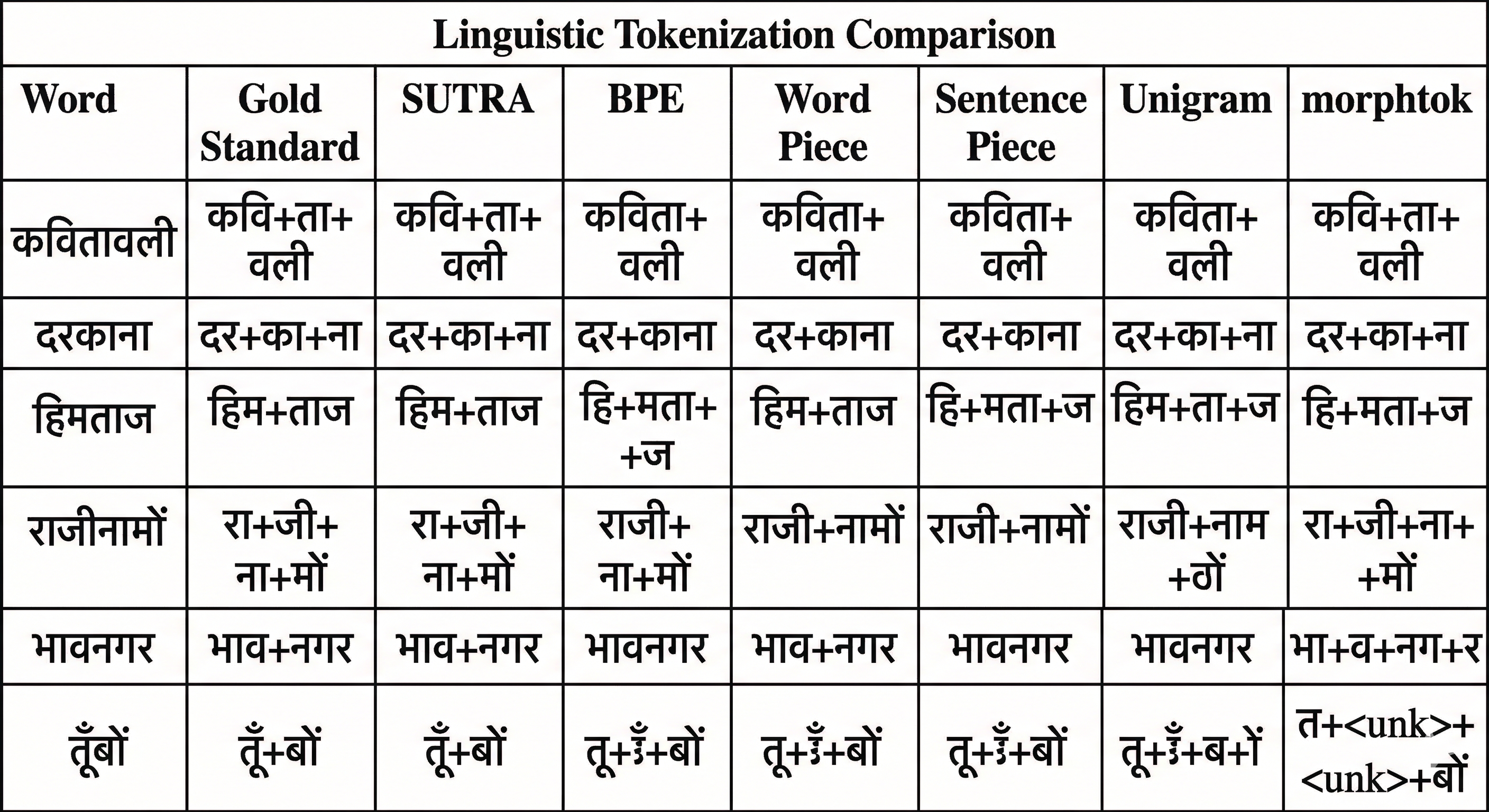
We construct a gold-standard morphological split dataset for Hindi, Marathi, and Gujarati via a three-stage pipeline: IndicCorp vocabulary extraction, adapted SampoNLP decomposition, and Gemini-assisted verification with explicit root restoration.
| Dataset | Langs | Size | Verification |
|---|---|---|---|
| UniMorph 4.0 | Multi (partial Indic) | ~10M | Algorithmic |
| MorphyNet | 15 (no Indic) | 10.6M | Manual (expert) |
| GujMorph | Gujarati | ~80k | None |
| Ours (Gold) | Hi, Mr, Gu | 560k | LLM-verified |
| Language | Source | Unique words |
|---|---|---|
| Hindi | IndicCorp | ≈ 160,000 |
| Marathi | IndicCorp | ≈ 200,000 |
| Gujarati | IndicCorp | ≈ 200,000 |
| Total | ≈ 560,000 |
| Tokenizer | Hindi | Marathi | Gujarati | |||
|---|---|---|---|---|---|---|
| F1 | Fert. | F1 | Fert. | F1 | Fert. | |
| BPE (ACL'16) | 0.482 | 1.285 | 0.470 | 1.225 | 0.591 | 1.126 |
| WordPiece | 0.411 | 1.214 | 0.527 | 1.300 | 0.596 | 1.173 |
| SentencePiece | 0.438 | 1.315 | 0.083 | 1.183 | 0.591 | 1.156 |
| Unigram | 0.439 | 1.310 | 0.507 | 1.256 | 0.669 | 1.137 |
| SuperBPE | 0.089 | 2.517 | 0.084 | 3.084 | 0.096 | 3.113 |
| MorphTok | 0.190 | 2.601 | 0.216 | 3.482 | 0.247 | 3.494 |
| SuTRA (Ours) | 0.586 | 1.412 | 0.617 | 1.755 | 0.584 | 1.454 |
| Language | Linear (Layer 0) | MLP (Layer 2+) | ||
|---|---|---|---|---|
| SuTRA | BPE | SuTRA | BPE | |
| Hindi | 0.4464 | 0.3329 | 0.5048 | 0.3358 |
| Marathi | 0.4634 | 0.4619 | 0.5331 | 0.4649 |
| Gujarati | 0.4624 | 0.4640 | 0.5055 | 0.4510 |
| Tokenizer | Hindi → Marathi | Marathi → Hindi | ||
|---|---|---|---|---|
| chrF2 | COMET | chrF2 | COMET | |
| BPE | 24.62 | 0.5054 | 36.55 | 0.6253 |
| WordPiece | 30.37 | 0.6093 | 27.18 | 0.5223 |
| SentencePiece | 25.01 | 0.4964 | 28.10 | 0.5147 |
| Unigram | 26.55 | 0.5157 | 29.19 | 0.5349 |
| SuperBPE | 15.84 | 0.3047 | 16.27 | 0.3422 |
| MorphTok | 26.75 | 0.5750 | 29.42 | 0.6007 |
| SuTRA (Ours) | 29.96 | 0.5752 | 38.84 | 0.6554 |
| Tokenizer | Hindi | Marathi | Gujarati | |||
|---|---|---|---|---|---|---|
| Jac. | R.Aff. | Jac. | R.Aff. | Jac. | R.Aff. | |
| BPE | 0.386 | 0.228 | 0.305 | 0.324 | 0.319 | 0.296 |
| Unigram | 0.363 | 0.232 | 0.294 | 0.340 | 0.320 | 0.308 |
| WordPiece | 0.413 | 0.249 | 0.293 | 0.355 | 0.314 | 0.316 |
| SentencePiece | 0.371 | 0.235 | 0.298 | 0.325 | 0.321 | 0.287 |
| SuperBPE | 0.624 | 0.146 | 0.655 | 0.127 | 0.631 | 0.126 |
| MorphTok | 0.801 | 0.067 | 0.823 | 0.055 | 0.792 | 0.051 |
| SuTRA (Ours) | 0.875 | 0.042 | 0.885 | 0.038 | 0.788 | 0.040 |
@inproceedings{rathore2026sutra,
  title     = {SuTRA: Structurally-Unified Tokenization with Root Awareness},
  author    = {Rathore, Vaibhav and Gole, Siddhant and Telwadkar, Dadhichi and
               Bhatia, Rooshil and Ruparel, Maulik and Sureka, Siddharth and Bhargava, Neha},
  booktitle = {Proc. Interspeech 2026},
  year      = {2026},
  url       = {https://drive.google.com/file/d/1Me6fn5_VEFrSLhorfP6YdNP-z2wrgh3Y/view?usp=sharing}
}